
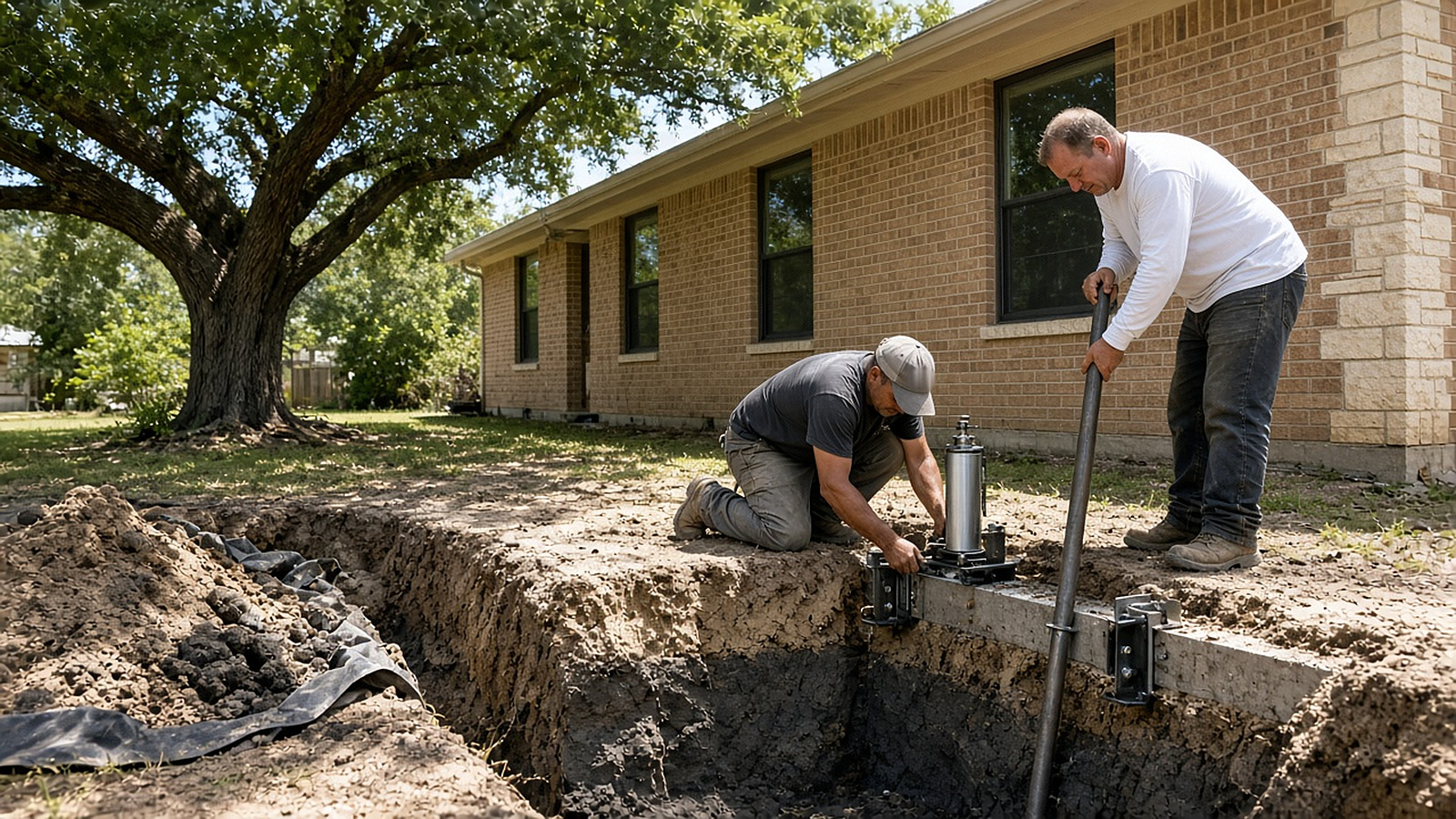
Foundation Repair in Converse, TX
Doors that began to stick after a dry summer, a crack working its way across the brick, a floor that leans toward one corner. This is a plain guide to Foundation Repair in Converse, TX: what the clay under Bexar County does, the four ways houses get fixed, and what a visit looks at.
What Do Converse Homeowners Ask First?
Most calls start with something seen inside the house: a crack over a doorway, a door that will not latch, or a floor that feels off. The four questions below come up most often. One sign alone can be minor; several together, or a crack that keeps growing, are worth an inspection.
How can I tell if my Converse house has a foundation problem?
+−
Notice several signs appearing together: stair-step cracks through exterior brick or stone mortar, diagonal drywall cracks over doorways and windows, interior doors that bind or swing open, noticeable floor slope toward one corner, gaps separating baseboards from flooring, or cracks across the garage slab. While a single hairline crack can be harmless, multiple symptoms or cracks that steadily widen over months point to subsoil settlement. Precise floor elevation readings show whether the structure has moved.
Are small cracks in brick or stone normal on a South Texas house?
+−
Hairline fissures in exterior mortar or concrete caused by initial material curing and thermal shrinkage are common throughout South Texas. However, stair-step cracks that run through mortar joints, openings wider than a coin's edge, or cracks that continue to expand following summer droughts indicate differential foundation movement. Learn more on our Foundation Crack Repair guide before cosmetic sealing.
Does homeowners insurance cover foundation repair in Texas?
+−
Standard Texas homeowner insurance policies typically exclude damage resulting from natural settling, soil earth movement, drought desiccation, and wear over time. Coverage varies significantly depending on specific policy endorsements, such as accidental plumbing leaks beneath a slab. Always review your exact insurance policy terms and speak directly with your insurance representative. Nothing on this site constitutes insurance advice.
What does foundation repair typically cost?
+−
National cost guides list a typical foundation repair project at roughly $2,200 to $8,100, with individual foundation piers running roughly $1,000 to $3,000 each in national guides, and minor crack sealing at roughly $250 to $800 per crack. The physical condition and footprint of your house decide the real cost. A technician confirms the method and price after an inspection.
Four more common questions, about timing, staying home during the work, watering in a drought and slab versus pier and beam, are answered on the FAQ page.
Which Kind of Foundation Repair in Converse, TX Fits Your House?
It depends on how the house was built and what the ground is doing. Homes poured on a slab usually need slab repair or piering; raised homes over a crawlspace usually need pier and beam work; cracks get sealed only after the cause is known. A technician confirms the method after seeing the house.
Slab-on-grade means one concrete slab poured on the ground; pier and beam means the floor framing sits on beams carried by piers over a crawlspace. Many houses around Converse are slab homes with brick or stone on the outside, and some older ones sit on piers.
Compare all four servicesWhy Does the Ground Move Under Converse Homes?
Much of central Bexar County sits on dark Blackland Prairie clay that swells when it gets wet and shrinks as it dries. Long dry stretches followed by soaking rain keep that swing going, and because the ground rarely moves evenly, one side of a house can shift more than another.
Black clay that changes size
Houston Black clay dominates central and eastern Bexar County, possessing an exceptionally high shrink-swell capacity. The Texas Master Naturalists (Alamo chapter) highlight this intense soil expansion as the primary catalyst for foundation shifting in the area. Locally nicknamed "black gumbo", this heavy subsoil can exert thousands of pounds of upward pressure when soaked and contract sharply during dry months.
Wet, then dry, then wet again
Dry, cracked clay takes in water quickly through deep fissures, while moist clay absorbs rainfall very slowly, as documented by USDA soil surveys. A sudden cloudburst following a prolonged South Texas drought saturates outer grade beams while central ground remains bone-dry. Downspout discharge points, mature tree roots, and sloped flowerbeds create uneven moisture zones that pull foundations out of level.
Caliche, stone and brick
Caliche layers cemented by calcium carbonate appear beneath some lots around San Antonio, altering digging depth and influencing how underpinning piers achieve firm load-bearing support. Rigid masonry veneers like limestone and brick cannot flex under movement; when a perimeter footing settles even a fraction of an inch, stress fractures run through mortar joints.
The clay is not the whole story. The swing between wet and dry is.
Seeing new cracks after a dry spell?
Call and describe what changed. We will explain what an inspection looks at.
Which Cities Near Converse Do You Serve?
Converse and three neighbors that share its clay and its edge of Randolph: Schertz, Live Oak and Universal City. Nearby parts of Bexar County may be covered too, so call to check availability for your street.
Converse
Home base in northeastern Bexar County, on FM 1976.
Schertz
Along Cibolo Creek, where Bexar meets Guadalupe County.
Live Oak
Near where I-35 meets Loop 1604.
Universal City
Beside the Randolph airfield, on Pat Booker Road.
What Happens After You Call About Your Foundation?
A short phone call about what you are seeing, then a visit to walk the outside, check doors, windows and walls inside and take floor elevation readings. You get a plain explanation of the cause and the options, and nothing is decided on the spot.
A phone call
Say what you are seeing and when you first noticed it. Photos of cracks taken with a coin for scale help establish context. You get an immediate idea of what a visit covers and what symptoms suggest about soil movement.
A walk around and floor readings
Outside: grading, gutters, downspouts, trees, the brick or stone veneer and the exposed slab edge. Inside: doors, windows, drywall, and a thorough set of floor elevation readings to map which corners sit high or low.
A plain explanation
We explain whether changes reflect active movement or ordinary shrinkage, what is likely driving it, which repair method fits, and the price, confirmed by the technician. You decide in your own time without high-pressure sales.
The work, then a second set of readings
Before any digging, Texas811 is contacted at least two business days ahead to mark public utility lines; private lines such as lawn sprinklers are not marked by 811 and need care. After the work the floor is read again and drainage advice is given.
What is your house telling you?
Phone calls only. Call to check availability.